All forms of displaying tobacco products are prohibited. On September 21st, under the chairmanship of the Standing Vice Chairman of the National Assembly Do Van Chien and the direction of the Vice Chairman of the National Assembly Nguyen Thi Thanh, the Standing Committee of the National Assembly gave its opinion on the draft Law amending and supplementing a number of articles of the Law on Prevention and Control of Tobacco Harm.
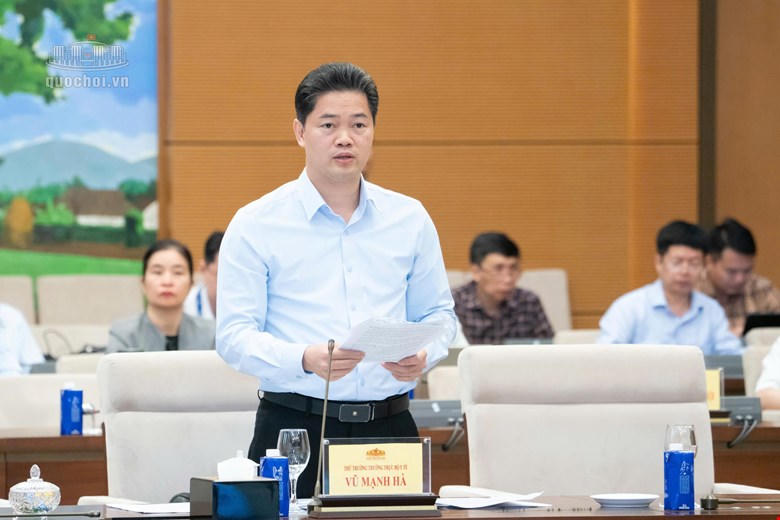
At the meeting, the Permanent Deputy Minister of Health, Vu Manh Ha, stated that the report summarizing 13 years of implementing the Law on Tobacco Control shows that thanks to many efforts in tobacco control, the rate of conventional cigarette use among adult men has decreased, and the rate of exposure to passive smoking has also significantly decreased in households, public places, and workplaces. However, these achievements are at risk of being affected and undermined by the increasing rate of use of new tobacco products, mainly e- cigarettes and heated tobacco products, especially among young people. E-cigarettes use many flavorings and chemicals, so they can be exploited for drug use through mixing. Users can arbitrarily increase the nicotine level excessively or add drugs and other addictive substances without being detected.
Research into the experiences of countries around the world and domestic practices shows the necessity of adding a regulation “Prohibiting all forms of displaying tobacco products” at points of sale in order to limit new cigarette smoking and encourage smokers to quit.
Regarding the scope of regulation, according to Mr. Ha, it remains the same as the Law on Prevention and Control of Tobacco Harm. The content includes additional regulations prohibiting the production, trading, storage, transportation, export, import, transit, temporary import, re-export, transshipment, possession, and use of e-cigarettes, heated tobacco products, and other tobacco products; prohibiting the production, sale, export, and import of electronic devices, component assemblies, separate components (parts), and solutions for assembling and producing e-cigarettes, heated tobacco products, and other tobacco products; and prohibiting the display of tobacco products.
In addition, amendments and additions to “certain prohibited acts” in Article 9 of the Law on Prevention and Control of Tobacco Harm (Clause 4, Article 1 of the Draft Law) are proposed. The reason for adding prohibited acts for e-cigarettes, heated tobacco products, other tobacco products, and electronic devices and components used to assemble e-cigarettes is to comply with the Investment Law, Resolution No. 173/2024/QH15 of the National Assembly, as proposed by the Ministry of Finance and the Ministry of Industry and Trade, and to address the reality of the emergence of new products containing illegal nicotine that harm human health, and the development of tobacco sales on online platforms and websites, which makes control difficult.
Amend and supplement the regulations on “tobacco business management” in Clause 1, Article 19 of the Law on Tobacco Control (Clause 5, Article 1 of the Draft Law). The reason for the amendment is to conform with the List of conditional investment and business sectors in the Investment Law (2025) (changes to regulations on tobacco business) and Resolution No. 66.18/2026/NQ-CP dated May 18, 2026 of the Government on decentralization, reduction, and simplification of administrative procedures and business conditions (abolishing administrative procedures for tobacco trading licenses).
Amendments and additions to regulations on controlling investment in tobacco production. In addition, the regulations on “control of investment in tobacco production” in Clause 4, Article 21 of the Law on Prevention and Control of Tobacco Harm (Clause 6, Article 1 of the draft Law) are amended and supplemented. The reason for the amendment is to align with the Intellectual Property Law and the decentralization policy proposed by the Ministry of Industry and Trade, which is the managing ministry of the sector (decentralization from the Prime Minister to the Minister of Industry and Trade). The regulations on “control of domestic tobacco consumption” in points c and d of Clause 1, Clause 2, and Clause 3, Article 22 of the Law on Prevention and Control of Tobacco Harm (Clause 7, Article 1 of the draft Law) are also amended and supplemented. The reason: As proposed by the Ministry of Industry and Trade, this aims to create favorable conditions for tobacco manufacturing enterprises within their permitted scope, enabling them to proactively develop long-term production, business, and investment strategies and plans.
During the preliminary review of the draft Law amending and supplementing a number of articles of the Law on Prevention and Control of Tobacco Harm, Mr. Nguyen Dac Vinh, Chairman of the Committee on Culture and Social Affairs, stated that the draft Law is fundamentally consistent with the Party’s guidelines and policies, especially institutionalizing the viewpoint of “Strongly shifting from a mindset focused on examination and treatment to proactive disease prevention” and the goal of “strengthening control of risk factors affecting health such as alcohol, beer, and tobacco” as outlined in Resolution No. 72-NQ/TW dated September 9, 2025, of the Politburo on some breakthrough solutions to strengthen the protection, care, and improvement of people’s health.
However, the Standing Committee noted that the draft Law’s specific provisions have relaxed the measures and tools for controlling tobacco, such as: abolishing the regulation on “tobacco sales licenses” for tobacco businesses, wholesalers, and retailers (Clause a, Article 25, Point 1 of the current Law); abolishing the regulation on controlling investment in tobacco production and processing for export exceeding the permitted production volume (Clause 6, Article 21 of the current Law); and abolishing the regulation on tobacco counseling and rehabilitation facilities (Clause 2 and Clause 4, Article 17 of the current Law).
According to this Committee , this will impact accessibility, increase user numbers, and affect the guarantee of gender equality. The drafting agency is requested to add a more specific assessment of the gender impact of the amended regulations, instead of the general descriptions in the submitted documents; and to continue researching and supplementing the practical basis to find appropriate solutions, ensuring that policies for ethnic minorities are feasible and effective.